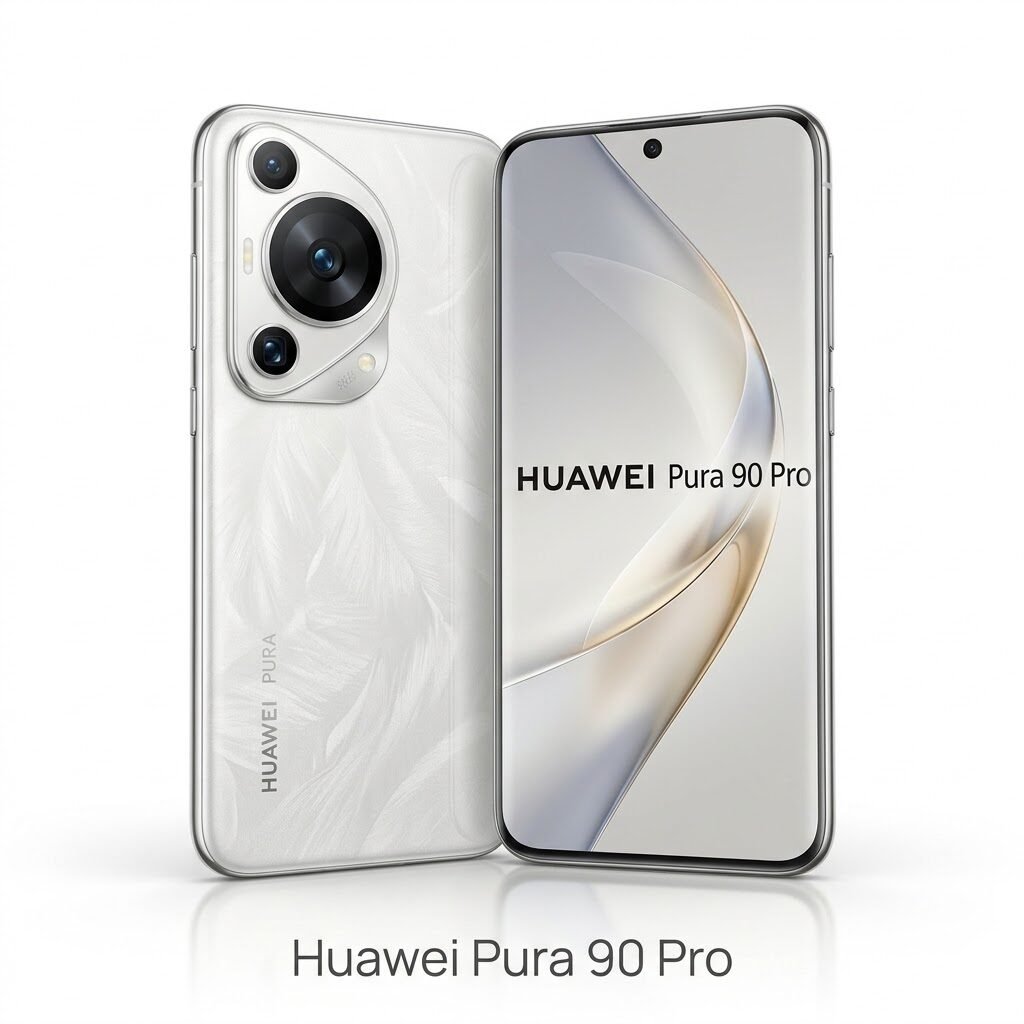
Huawei Pura 90 Pro Key Features
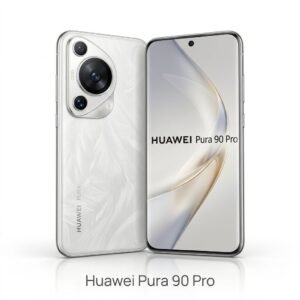
Huawei Pura 90 Pro Specifications
Processor & Software
- Operating system
- HarmonyOS 6.1 (China version)
- Chipset / SoC
- Kirin 9030S
Build & Design
- Dimensions
- 157.8 × 74.5 × 8.2 mm
- Weight
- 213.5 g (approx.)
- Water / dust resistance
- IP68 (2 m freshwater, 30 min); IP69
Display
- Display technology
- LTPO OLED, P3 wide colour gamut
- Screen size
- 6.6 inches
- Resolution
- 2760 × 1256 pixels
- Pixel density (ppi)
- 460 ppi
- Refresh rate
- 1–120 Hz adaptive
- Touch sampling rate
- 300 Hz
- Display protection
- Second-generation Kunlun Glass
Network & Frequency
- SIM configuration
- Dual nano-SIM
- eSIM support
- Not supported (China version)
Memory & Storage
- RAM
- 12 GB / 16 GB
- Internal storage
- 256 GB / 512 GB / 1 TB
- Memory card slot
- No memory card expansion
Cameras & Video
- Rear camera setup
- 50 MP, f/1.4–f/4.0 variable aperture, OIS
- Ultrawide camera
- 12.5 MP, f/2.2
- Telephoto camera
- 50 MP macro telephoto, f/2.1, OIS, 4× optical zoom
- Rear camera features
- XMAGE; True-to-Colour camera; autofocus; RAW shooting
- Optical stabilization
- Main and telephoto cameras
- Rear video recording
- Up to 4K (3840 × 2160); AIS stabilization
- Front camera
- 13 MP ultrawide, f/2.0, autofocus
- Front video recording
- Up to 4K (3840 × 2160)
Connectivity
- Wi-Fi
- Wi-Fi 7 (802.11be), 2.4/5 GHz
- Bluetooth
- Bluetooth 6.0
- Positioning / GNSS
- GPS, GLONASS, BeiDou, Galileo, QZSS, NavIC
- NFC
- Yes
- USB
- USB Type-C
- Satellite features
- BeiDou satellite messaging (mainland China only)
Sound & Multimedia
- Speakers
- Stereo speakers; Huawei Histen
- 3.5mm headphone jack
- USB Type-C digital audio
Sensors & Security
- Sensors
- Gyroscope, compass, light, proximity, infrared, Hall, colour temperature
- Fingerprint reader
- Side-mounted fingerprint sensor
Durability & Repairability
- IP rating
- IP68 / IP69
- Glass / frame durability
- Second-generation Kunlun Glass
Battery & Charging
- Battery capacity
- 6000 mAh typical (5850 mAh rated)
- Wired charging
- 66 W Huawei SuperCharge wired
- Wireless charging
- 50 W Huawei wireless SuperCharge
- Reverse charging
- 5 W wired reverse; wireless reverse
- Removable battery
- No
What the Huawei Pura 90 Pro offers
The Huawei Pura 90 Pro is a camera-focused flagship built around a compact-by-flagship-standards 6.6-inch LTPO OLED display, Huawei’s Kirin 9030S platform and a 6000 mAh battery. Its most useful photography advantage is not simply the megapixel count. The combination of a variable-aperture main camera and a stabilised 4× telephoto gives photographers different ways to control perspective and depth. For a buyer in Pakistan, the bigger decision is whether the Chinese HarmonyOS software and the exact imported handset fit everyday app and network needs.
No verified local selling price is included in this guide. A currency conversion from a Chinese price would not represent a Pakistani retail quotation, especially once shipping, seller margin, taxes and any device registration cost are involved. Treat the listed hardware as the manufacturer’s China-market specification, not a promise that a particular Pakistani retailer carries the same configuration.
A manageable body with a premium display
The 157.8 mm height and 74.5 mm width make this model notably easier to handle than larger camera flagships. At approximately 213.5 g, however, it is not lightweight. The front uses second-generation Kunlun Glass, and the body carries IP68 and IP69 laboratory resistance ratings. These ratings describe controlled tests; they are not a recommendation to submerge a phone, and liquid damage protection is not equivalent to a warranty against water damage.
The OLED panel has a 2760 × 1256 resolution and an adaptive 1–120 Hz refresh rate. That combination makes text look fine while allowing the screen to reduce its refresh activity when little changes on the display. A 300 Hz touch sampling specification describes input polling, not a promise that every game will run at that frame rate. The 6.6-inch size is a meaningful reason to choose the Pro rather than the much larger Pro Max.
Kirin 9030S and the HarmonyOS question
Huawei lists the Kirin 9030S chipset and HarmonyOS 6.1 for the Chinese Pura 90 Pro. The processor is the important hardware identifier; precise benchmark scores and comparative thermal results should not be inferred without repeatable tests of this exact variant. Everyday responsiveness depends on software optimisation, storage condition and the apps actually installed.
Software compatibility deserves attention before buying. A China-market HarmonyOS phone should not be treated as interchangeable with an Android handset running Google Mobile Services. App installation, Google account workflows, banking apps, notifications, maps and Android application compatibility can differ. Check each essential application in person on the actual phone, and do not assume an international EMUI product page describes this Chinese variant.
Memory and storage choices
The official Chinese specification lists 12 GB and 16 GB RAM options, with internal storage capacities from 256 GB to 1 TB. Those figures describe the supported range and do not by themselves establish every possible RAM-and-storage pairing. Storage expansion through a removable memory card is not supported, making the selected internal capacity a long-term decision.
Photographers recording 4K clips, keeping RAW files or downloading offline video may benefit from more than the base capacity. Buyers who mostly use messaging and streaming can weigh a smaller configuration against the extra cost. Before paying, open the settings page to confirm physical RAM and internal storage rather than relying on advertised software memory expansion or a handwritten shop label.
Camera flexibility is the main attraction
The rear system includes a 50 MP main camera with a variable f/1.4–f/4.0 aperture and optical image stabilisation, a 12.5 MP ultra-wide unit and a 50 MP macro telephoto with roughly 4× optical magnification. The variable aperture can give the imaging system more control over incoming light and depth characteristics. Optical stabilisation helps counter small hand movements, but it cannot freeze a moving subject in every lighting condition.
The macro telephoto can frame small subjects from a more comfortable distance than a conventional close-focusing wide camera. Huawei also lists XMAGE imaging features and RAW capture. Neither a sensor resolution nor an image-processing label proves real-life image quality on its own; skin tones, night noise and exposure behaviour are still worth inspecting using photographs made with the exact unit.
Selfies and recorded video
A 13 MP autofocus ultra-wide selfie camera is useful for group compositions and video calling. The company lists up to 4K video on front and rear cameras, with AIS stabilisation on the main recording pipeline. The phone also advertises very high frame-rate slow-motion capture, but Huawei specifies that its headline 960 fps mode uses AI frame interpolation rather than 960 native captured frames per second.
For anyone filming classes, travel or product videos, the practical questions are microphone behaviour, available storage, heat during long clips and how footage moves to a computer. A short supervised recording test answers more than a marketing claim about cinematic video. Confirm the recording mode you require is actually selectable on the software build of the device being sold.
Battery, charging and accessories
The typical battery capacity is 6000 mAh, with 5850 mAh given as the rated figure. Huawei specifies up to 66 W wired SuperCharge and 50 W wireless SuperCharge, plus reverse charging functions. The maximum wired rate requires compatible Huawei charging equipment; a generic USB-C power adapter should not be assumed to reach the advertised peak.
Wireless charging at the stated maximum similarly requires supported Huawei hardware. Actual charge speed changes with temperature, battery condition and power management. Battery runtime cannot be expressed as a reliable fixed number of hours from capacity alone, because the screen, camera use, signal quality and background activity matter. Check the included adapter and plug standard if buying a Chinese retail package.
Connectivity and Pakistan-specific checks
The Chinese variant supports two nano-SIM cards and does not support eSIM according to the official product page. It includes Wi-Fi 7, Bluetooth 6.0, NFC and multi-system positioning. Huawei lists BeiDou satellite messaging, but the relevant service is restricted to mainland China; it should not be presented as an emergency-messaging service available in Pakistan.
For local use, request the exact model identifier and verify support for your mobile operator’s LTE and 5G frequencies rather than assuming every import shares identical bands. Separately check PTA registration or approval through the appropriate Pakistani verification process. A handset being offered for sale is not evidence of its tax or registration status.
Pura 90 Pro versus Pura 90 Pro Max
The standard Pro makes more sense for a buyer who prioritises a more manageable phone and still wants a dedicated telephoto system. Its 6.6-inch panel and 213.5 g weight are meaningfully different from the Pro Max’s 6.9-inch screen and 230.5 g body. Both share the Kirin 9030S, but the bigger model upgrades the ultra-wide and telephoto hardware and supports faster charging.
If you frequently photograph distant subjects or want the largest display in the range, those Pro Max advantages could be worth carrying the extra weight. If portability and everyday photography matter more, the standard Pro is already well equipped. Either choice requires the same careful scrutiny of HarmonyOS app compatibility and Pakistan network support.
Who should consider it
The Huawei Pura 90 Pro best suits a user comfortable with the Huawei ecosystem who values a versatile rear camera and a high-resolution OLED screen in a relatively compact flagship. It is less straightforward for somebody whose work depends on a specific Android service, Google-dependent application or locally supported warranty.
Ask for a hands-on software demonstration, verify the installed capacity and IMEI, check the legitimate registration status and obtain a clear written return policy before finalising an import purchase. Those checks matter more than an unverified PKR price or a promise that all Chinese firmware behaves like an international model.