
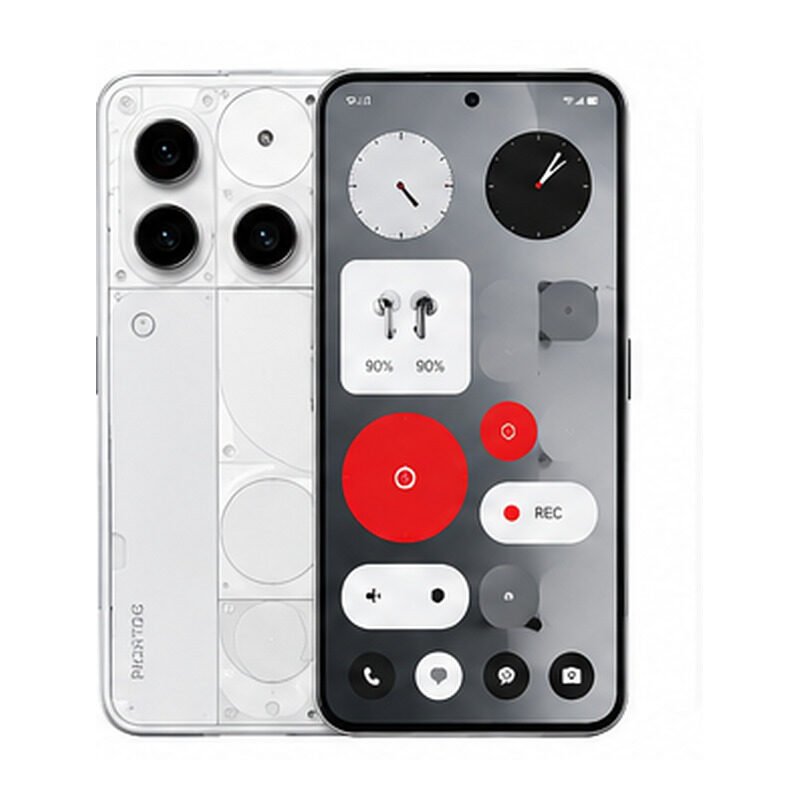
Nothing Phone (3) Key Features
Nothing Phone (3) Specifications
Body & Design
- Weight
- 218 g
- Build materials
- Transparent-inspired construction; rear Glyph Matrix
- Available colors
- Black, White
Network & Cellular
- Network technology
- 5G
Software & Processor
- Operating system
- Android 15
- User interface
- Nothing OS 3.5
- Chipset / SoC
- Qualcomm Snapdragon 8s Gen 4
RAM & Storage
- RAM
- 12 GB / 16 GB
- Internal storage
- 256 GB / 512 GB
Display
- Display technology
- 6.67-inch AMOLED
- Screen size
- 6.67 inches
- Resolution
- 1260 x 2800
- Refresh rate
- 120 Hz
Camera & Video
- Rear camera setup
- 50 MP main with OIS
- Rear video recording
- 4K video recording
- Front camera
- 50 MP
Battery & Charging
- Battery capacity
- 5150 mAh
- Wired charging
- 65 W wired; 15 W wireless
- Wireless charging
- 15 W
Audio
- Stereo speakers
- Yes
Wireless & Connectivity
- Wi-Fi
- Wi-Fi 7
- Bluetooth
- Bluetooth 6.0
- NFC
- Yes
Sensors & Security
- Fingerprint reader
- In-display fingerprint
Durability & Repairability
- IP rating
- IP68
Additional Information
- Technical notes
- Rear dot-matrix Glyph interface
Price last checked: 2026-10-30
Prices may vary by variant and local market.
Overview and Pakistan buying context
Nothing Phone (3) is a 5G smartphone built around a 6.67-inch AMOLED, Qualcomm Snapdragon 8s Gen 4 and 5150 mAh battery. Its defining appeal is the most fully equipped Nothing phone in this group. The published hardware describes what the phone can do; it does not establish the frame rates, battery endurance or camera performance of an untested Pakistani retail unit.
For a buyer in Pakistan, the first task is to compare a genuine quote for the same RAM and storage variant. Available configurations include 12 GB / 16 GB RAM and 256 GB / 512 GB storage, but not every combination is sold in every market. A price seen for an imported, unregistered or used phone should not be treated as the official new, PTA-approved retail price. Before ordering, request the exact model number, receipt and written details of warranty coverage.
Design, display and handling
The 6.67-inch AMOLED runs at up to 120 Hz with 1260 x 2800 pixel resolution. It is suited to long reading sessions, maps and video because the panel has more useful screen space than a small compact phone. Refresh rate primarily changes the smoothness of scrolling and supported animation. It does not make a low-frame-rate video sharper, and it cannot by itself make the chipset faster. The overall handling of this design is equally important: transparent-inspired construction; rear glyph matrix.
Processor, memory and everyday use
The Qualcomm Snapdragon 8s Gen 4 is paired with 12 GB / 16 GB physical RAM choices and 256 GB / 512 GB internal storage options. For messaging, navigation, browser tabs, documents and mainstream social apps, those specifications set reasonable expectations. Long gaming sessions, editing workloads and heat behaviour cannot be judged by chipset naming alone. For gaming, look for a measured comparison using the exact model and game settings, rather than a quoted maximum refresh rate or a synthetic benchmark from an unrelated phone.
Software experience
The device was introduced with Nothing OS 3.5 based on Android 15. Software versions can change through updates, and a retail phone may already be running a later build. Check the available security update in Settings after setup, back up data before major upgrades, and keep app permissions under control. The clean or unusual appearance of a user interface is a preference, not proof that every app will run faster.
Design that looks unlike the other Nothing models
The Phone (3) uses the brand’s Glyph Matrix rather than the longer segmented lighting layout familiar from earlier phones. Its back arranges separate large camera circles and a small dot-based display. The style will appeal to some buyers and divide others. The design is worth inspecting in person because photos do not tell you whether the camera bumps, weight or button layout suit your grip.
Flagship-oriented hardware with a qualifier
Snapdragon 8s Gen 4 belongs above the 7-series chips in these midrange phones for compute headroom. Nevertheless, it is not the same component as every highest-priced Snapdragon flagship. For ordinary tasks it should have substantial capacity, but frame-rate promises in a particular game need exact tested evidence. The phone also carries a substantial battery and faster wired charging than the (3a) family.
Camera hardware and real-world expectations
Its camera set includes 50 MP main with OIS; 50 MP periscope telephoto with OIS; 50 MP ultrawide, plus a 50 MP front-facing camera. The useful distinction is the combined 50 MP wide, periscope and ultrawide arrangement, plus a high-resolution selfie camera. Use good daylight and steady framing to compare detail, then look at several real samples from the model before judging portraits, faces and night scenes. Advertised video support includes 4K video recording; available frame-rate choices can differ by lens, resolution and mode. Neither a megapixel figure nor optical stabilisation automatically guarantees sharp footage.
Imaging flexibility
Three distinct 50 MP rear cameras give the Phone (3) standard, long-range and ultrawide shooting options. Stabilisation on both the main and periscope lenses is especially relevant to handheld framing. A 50 MP front camera adds more capture resolution, but image processing and lighting remain critical. This is a far more versatile camera specification than the two-camera hardware in a (2a).
Price and ownership perspective
The higher-tier hardware only becomes a sensible purchase when the quoted Pakistani price accounts for approved status, warranty and service access. A heavily discounted (3a) Pro can offer optical zoom at much less cost, while the Phone (3) adds performance, build protection and wireless charging. Treat the premium as payment for a group of features, not a guaranteed improvement in every photo.
Battery and charging
The battery specification is 5150 mAh, with 65 W wired; 15 W wireless charging support. The charging figure is a maximum supported power mode, not a constant speed across the full cycle. Charging slows as the battery fills, and the adapter, cable, ambient temperature and phone temperature can affect the rate. Treat unsupported claims of exact screen-on time or full-charge minutes cautiously, particularly on imported devices with different software builds.
Connectivity, PTA approval and warranty
This model supports 5G mobile service, Wi-Fi 7 and Bluetooth 6.0. Network support depends on the frequency bands of the particular regional handset and the operator. A label saying “5G” does not establish coverage or compatibility with every Pakistani network. Check the physical SIM configuration, actual carrier bands and official device approval where needed. An imported phone may require separate registration before local cellular service can be used.
Alternatives and compromises
Against Nothing Phone (3a) Pro and Nothing Phone (4a) Pro, the clearest reason to choose this handset is the most fully equipped Nothing phone in this group. Its principal compromises include heavier build and higher price tier without a true top-end Snapdragon 8 Elite chip. Read those as practical purchasing trade-offs, not as a ranking derived from laboratory tests. A more expensive phone can be a worse match if you do not use its unique feature, while a cheaper variant can be a false saving if you need more storage or repair support.
Who should consider it
Before deciding, handle the screen, test speakers and microphones, take a brief test photograph, check charging and inspect the SIM tray where a seller permits it. Verify the IMEI against the box and a recognised approval channel, and get any claimed PTA approval or warranty in writing. For a used phone, also inspect battery condition, physical damage and signs of prior repairs. The most reliable purchase is a clearly identified device with an understandable total ownership cost, not merely the lowest advertised number.
Nothing Phone (2)

Nothing Phone (2a)
Nothing Phone (2a) Plus

Nothing Phone (3a)

Nothing Phone (3a) Lite

Nothing Phone (3a) Pro

Nothing Phone (4a)