
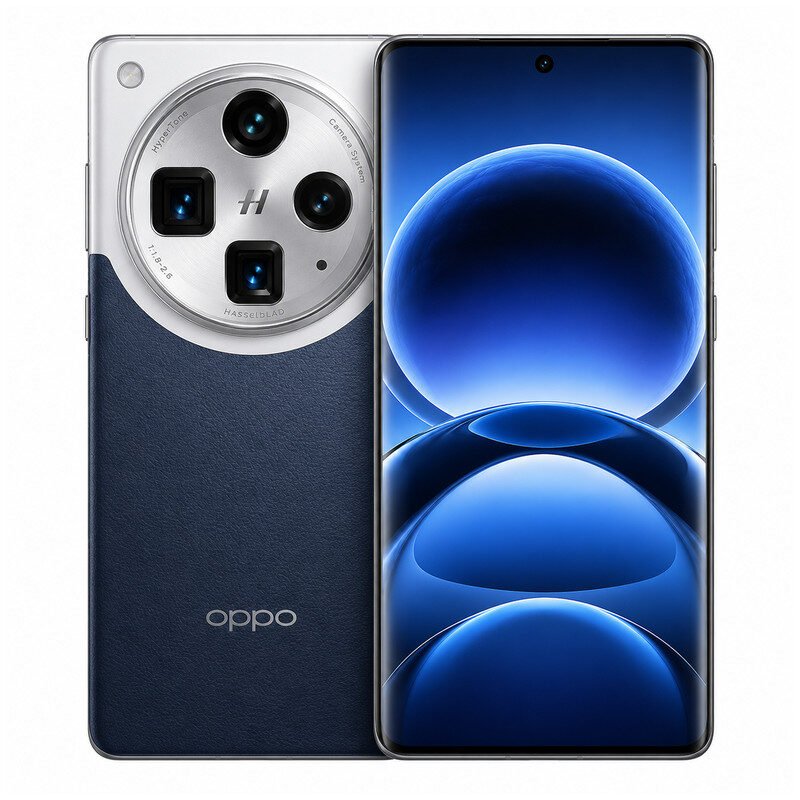
OPPO Find X7 Ultra Key Features
OPPO Find X7 Ultra Specifications
Body & Design
- Dimensions
- 164.3 × 76.2 × 9.5mm
- Weight
- 221g
Network & Cellular
- Network technology
- GSM / HSPA / LTE / 5G
- SIM configuration
- Dual Nano-SIM
Launch & Status
- Regional model codes
- PHY110
Software & Processor
- User interface
- ColorOS 14
- Chipset / SoC
- Qualcomm Snapdragon 8 Gen 3
- CPU
- 8-core
RAM & Storage
- RAM
- 12GB / 16GB
- RAM type
- LPDDR5X
- Internal storage
- 256GB / 512GB
- Storage technology
- UFS 4.0
- Memory card slot
- No microSD
- Memory configurations
- 12/256GB; 16/256GB; 16/512GB
Display
- Display technology
- LTPO AMOLED
- Screen size
- 6.82 inches
- Resolution
- 3168 × 1440
- Refresh rate
- 1–120Hz adaptive
- Brightness (nits)
- 4500 nits local peak
Camera & Video
- Rear camera setup
- 50MP 1-inch-type main, OIS
- Ultrawide camera
- 50MP autofocus
- Telephoto camera
- 50MP 3× periscope + 50MP 6× periscope, both OIS
- Rear video recording
- 4K up to 60fps
- Front camera
- 32MP
Battery & Charging
- Battery capacity
- 5000mAh typical
- Wired charging
- 100W SUPERVOOC wired
- Wireless charging
- 50W wireless charging
- Reverse charging
- 10W reverse wireless
Sensors & Security
- Fingerprint reader
- In-display
Price last checked: 2026-10-30
Prices may vary by variant and local market.
Overview and buying position
The OPPO Find X7 Ultra is a photography-focused China-market flagship with a 1-inch-type main sensor and two periscope zoom lenses. Its appeal is specific rather than universal: it makes sense for people focused on portraits, distant subjects, detailed landscapes and premium mobile imaging. The key trade-off is equally clear: its heavier camera-focused body and China-market firmware can complicate local ownership. That distinction matters more than a long specification list when comparing phones in Pakistan.
An official local retail price for the exact PHY110 variant could not be confirmed. A price shown for an unfamiliar variant, an unregistered import or an old retailer listing is not automatically the cost of the exact phone described here. Pay particular attention to the confirmed model number, memory configuration and the warranty paperwork before using any quoted figure as a comparison point.
Design, screen and practical handling
The design centres on a 221g body with a 6.82-inch high-resolution LTPO AMOLED screen and prominent circular four-camera housing. That physical arrangement determines how comfortable the handset feels for everyday use. A spec sheet gives size and weight, but grip, button accessibility, screen reflections and case fit are worth checking on the actual unit. Large or unusually shaped phones need more attention to pocket fit, especially if the camera housing protrudes.
The listed display details help explain the intended experience. Screen size alone does not determine clarity: resolution, panel technology, viewing angles and brightness each affect real use. A larger display gives room for reading and video, but can make one-handed operation more difficult.
Details that distinguish this model
The two periscope cameras set the Ultra apart from the ordinary Find X7. A roughly 3-times optical view suits tighter portraits or moderate distance, while the longer 6-times view gives another native framing option. The 1-inch-type main camera sensor is also significant for the phone’s imaging priorities, although final photographs depend on light, stabilization and processing rather than sensor size alone.
Its 3168 × 1440 LTPO screen, 221g weight and 9.5mm body describe a phone designed around camera hardware rather than minimum size. The combination of 100W wired, 50W wireless and 10W reverse wireless charging should be compared with the standard X7’s 100W wired specification rather than assumed identical.
Processor, memory and everyday speed
The Qualcomm Snapdragon 8 Gen 3 underpins the experience. Performance expectations should come from its hardware class rather than an invented benchmark result. App loading, sustained workloads, available storage, background activity and software version all influence how responsive a particular handset feels.
Memory configurations matter. 12/256GB; 16/256GB; 16/512GB. Physical RAM should not be confused with virtual expansion, and the nominal storage number is not the amount left free after the operating system and preinstalled apps. Buyers who keep offline maps, photos and downloaded videos should plan space accordingly.
Camera hardware and realistic expectations
The wide camera uses a 50MP 1-inch-type sensor, alongside a 50MP ultrawide and two 50MP optical telephotos at approximately 3× and 6× focal ranges. A lens count or megapixel total cannot replace evidence about image processing, focus behaviour, movement and low-light results. There are no independently measured sample-image claims in this guide.
Different focal lengths serve different tasks: the main lens is the default for routine scenes, ultrawide helps with cramped views, and optical telephoto keeps distant framing more useful than relying on digital enlargement alone.
Display, video and long-term software detail
The 6.82 inches LTPO AMOLED screen is listed at 3168 × 1440 with 1–120Hz adaptive refresh. The official chipset is Qualcomm Snapdragon 8 Gen 3; the storage technology is UFS 4.0. In practice, that combination is aimed at smooth navigation and demanding software, but it does not prove a particular game frame rate or benchmark score. Those require a controlled test of the exact regional model.
Its video specification includes 4K up to 60fps. Recording resolution and frame rate describe supported formats, not final image quality. Stabilisation, lighting, the selected camera lens, thermal load and software processing affect the footage. This is particularly relevant for people switching between wide and telephoto views while shooting events or travel videos.
The interface is ColorOS 14. System updates can change camera processing, background app behaviour and network features; version support should be checked for the market-specific handset. An imported model can have different apps and regional services from a global one even when the processor name matches. Buyers should avoid assuming compatibility from screenshots of another variant.
Battery, charging and ownership costs
Its 5000mAh typical battery supports 100W wired and 50W wireless charging, with 10W reverse wireless functionality. A capacity figure is not a measured runtime guarantee: brightness, mobile reception, camera use, games and app activity can change energy consumption substantially. The rated and typical capacities should not be mixed when comparing manufacturer data.
Check the cable, adapter and charging protocol supplied with the exact retail box. A charger with the same printed wattage does not necessarily deliver the manufacturer’s proprietary fast-charge mode. Heat, battery age and usage while plugged in also affect the real charging experience.
Network compatibility and Pakistan considerations
OPPO identifies this phone as PHY110 in its China specifications. Imported stock needs model-number, network-band, PTA registration and software checks; the satellite edition is a separate product and must not be confused with the standard Ultra.
Two apparently identical listings can have different outcomes when one is an officially supported local unit and the other is imported. The relevant checks are IMEI identity, PTA registration, the actual supported bands, SIM setup and documentation for service. A market listing or a brand name alone cannot establish the approval status of a particular handset.
Strengths, limitations and alternatives
The strongest reason to consider this model is portraits, distant subjects, detailed landscapes and premium mobile imaging. That use case brings the most value from its stated hardware. Its weaker side is its heavier camera-focused body and China-market firmware can complicate local ownership; choosing it for a different priority may produce disappointment even if its headline numbers sound attractive.
A sensible comparison is Find X7 if cost and size matter more than the additional periscope lens. Compare the exact configuration rather than a headline model name. Think about how the display, cameras, app support and spare-parts access affect your own routine, and whether a feature you will use regularly deserves priority over another specification that merely looks impressive on paper.
Who should choose this phone?
OPPO Find X7 Ultra suits a buyer who understands its particular role and can verify the actual handset before spending money. It is intended for a buyer who values flagship hardware and understands that software region, warranty and local activation can be as consequential as camera performance.
Before committing, inspect the actual display, charging port, camera lenses and microphone; confirm that calls, data and fingerprint unlocking work with your own SIM when permitted. Match the box model number to the phone information menu, check the legitimate warranty, and compare the final cost rather than treating an advertised figure as an all-inclusive guarantee.

OPPO Reno15 Pro Max 5G
OPPO A5i Pro 5G

OPPO A6 Max

OPPO A6 5G

OPPO A6i 5G
OPPO F29 5G

OPPO F29 Pro 5G