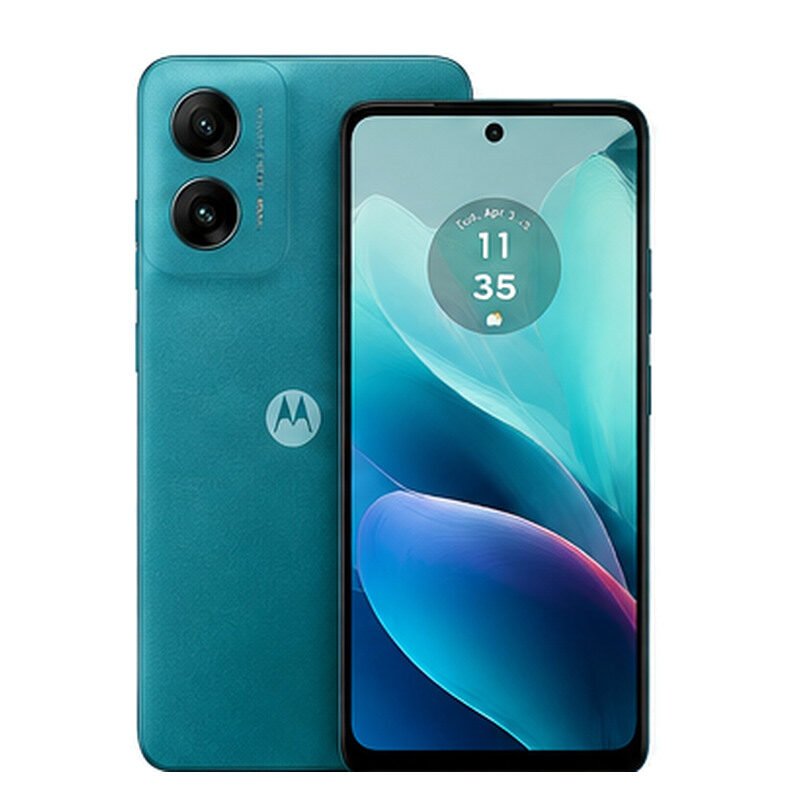
Motorola Moto G06 Key Features
Motorola Moto G06 Specifications
Body & Design
- Dimensions
- 171.35 × 77.50 × 8.31 mm
- Weight
- 194 g
- Available colors
- Pantone Tapestry; Pantone Arabesque; Pantone Tendril
Network & Cellular
- Network technology
- 4G LTE
Software & Processor
- Operating system
- Android 15
- Chipset / SoC
- MediaTek Helio G81 Extreme
RAM & Storage
- RAM
- 4GB / 8GB physical RAM (variant dependent)
- RAM type
- LPDDR4X
- Internal storage
- 64GB / 128GB / 256GB
- Memory card slot
- microSD card supported
- Expandable storage
- Up to 1 TB via microSD
Display
- Display technology
- 6.88-inch IPS LCD
- Screen size
- 6.88 inches
- Resolution
- 720 × 1640 pixels
- Refresh rate
- 120 Hz
- Display protection
- Corning Gorilla Glass 3
Camera & Video
- Rear camera setup
- 50 MP
- Rear video recording
- 1080p at 30fps
- Front camera
- 8 MP
Battery & Charging
- Battery capacity
- 5200 mAh
- Wired charging
- 10W wired charging
Audio
- Speakers
- Stereo speakers with Dolby Atmos
- Stereo speakers
- Yes
- 3.5mm headphone jack
- 3.5 mm audio jack
Wireless & Connectivity
- Wi-Fi
- 802.11 a/b/g/n/ac
- Positioning / GNSS
- GPS
- USB
- USB Type-C (USB 2.0)
Sensors & Security
- Fingerprint reader
- Side-mounted fingerprint sensor
- Face unlock
- Supported
Durability & Repairability
- IP rating
- IP64
Price last checked: 2026-10-30
Moto G06 price in Pakistan and buying position
Moto G06 has a 6.88-inch IPS LCD, MediaTek Helio G81 Extreme, 5200 mAh battery and 50 MP rear camera. It is a 4G phone, not a 5G device. That combination makes it a large-screen budget handset for reading, streaming and basic apps. The important buying decision is whether its display, camera arrangement and battery match how the phone will actually be used, rather than relying on a single headline number.
An independently confirmed, current Pakistan selling price is not available for this exact regional configuration, so a rupee figure is deliberately not quoted here. Local listings can mix imported units, different RAM options and units without official warranty. Compare the complete model name, physical memory, storage and seller documentation before treating two advertised offers as equivalent.
Design, screen quality and everyday handling
The 6.88-inch IPS LCD uses a 720 × 1640 pixels resolution and 120 Hz refresh rate. The HD-class resolution is sufficient for large interface elements and casual video, though fine text will not look as sharp as on a comparable Full HD panel. The high refresh rate can make swipes and menus look smoother when apps support it.
At 171.35 × 77.50 × 8.31 mm and 194 g, its proportions are worth checking in person if one-handed typing matters. A larger display benefits reading, video and split-screen layouts, but can also require more thumb travel. Screen protectors and cases must match the precise model, because similarly named Moto G variants may have different camera cutouts or frames.
The IP64 designation provides a defined degree of dust and splash resistance; it is not an invitation to submerge the phone. In day-to-day Pakistan use, a well-fitting case and sensible heat management matter more than advertising language about toughness.
Processor, physical RAM and realistic speed
Inside is the MediaTek Helio G81 Extreme, paired with 4GB / 8GB and 64GB / 128GB / 256GB built-in storage across documented versions. Basic tasks such as messaging, navigation, shopping apps, scanning QR codes and streaming are much more relevant performance tests for this price class than peak synthetic scores.
Actual responsiveness depends on the physical RAM in the purchased unit, free storage, software load and background apps. Motorola RAM Boost features use part of internal storage as virtual memory; they do not turn a smaller physical-memory model into an equivalent higher-RAM handset. For users switching repeatedly between several heavy apps, selecting more actual RAM is usually more meaningful than an advertised expanded-memory total.
Because the chipset and modem are 4G-based, buying this device for future 5G access would be a mistake. Its strength is familiar LTE calling and data in locations with a reliable compatible network. Intensive 3D games deserve reduced graphics settings, realistic expectations and attention to device temperature.
Cameras: what the hardware actually offers
The primary rear camera is rated at 50 MP, with a 8 MP front camera. The published setup does not justify treating the phone as a multi-zoom or interchangeable-lens camera system. Compared with the G05, the G06 prioritises display area and splash protection but does not upgrade the screen resolution to Full HD.
For portraits, pets and street scenes, good light, stable hands and sensible framing will generally matter more than aggressive digital zoom. A bigger megapixel label is not a guarantee of brighter low-light photos. Processing, lens optics, exposure and subject movement shape the outcome.
The published camera video capability includes 1080p at 30fps. Video stability, autofocus and low-light quality should not be assumed to match a premium camera phone. If recording school functions, family gatherings or shop product videos is a major use, examine original samples from the exact model and avoid judging quality from heavily compressed social-media clips.
Battery, charging and long-day practicality
The 5200 mAh battery and 10W wired charging make charging habits an important part of the decision. Capacity is useful context, but screen brightness, mobile signal, navigation and background syncing all influence the actual number of hours between charges.
Published battery-life marketing figures are measured under particular conditions and should not be treated as guaranteed screen-on time. During hot-weather travel, recording video, playing games or using mobile data in poor-signal areas, consumption may climb. Lower display brightness and checking which apps use background power are more dependable ways to improve endurance than assuming every large battery will last the same number of days.
Charging wattage describes the supported charging capability, not a constant speed from an empty battery to a full one. The power adapter, USB cable, battery temperature and charging stage all affect results. Check the supplied adapter for the exact country package rather than assuming every import has the same charger.
Software, audio and wireless connections
This model is documented with Android 15 at launch. Motorola’s interface is relatively direct in presentation, but software features and future security support should be assessed for the particular variant and current installed build. A phone can receive updates without every regional SKU sharing the same schedule or feature set.
The wireless specification includes 802.11 a/b/g/n/ac Wi-Fi. USB Type-C and a standard 3.5 mm headphone connection cover familiar wired uses. Stereo speakers provide separate channels for video and casual listening, though small phone drivers cannot produce the depth of headphones or larger speakers. GPS support is useful for navigation, but precise positioning still depends on signal conditions.
Some features, including NFC, radio reception, SIM arrangement and selected mobile network bands, differ between country editions. That is why a global specification page should not be read as a guarantee of a specific Pakistani retail configuration. Buyers planning contactless payments, two active SIMs or microSD expansion should verify the physical tray and the exact product code.
Pakistan use: PTA, warranty and genuine variants
A phone sold in Pakistan needs a practical check beyond its international feature sheet. PTA compliance applies to the particular device identity and IMEI, not merely to the model name appearing on a box. No blanket PTA-approved claim is made for this model; confirm the status of the individual handset through the official PTA verification process before paying.
A retailer warranty, an import-shop service promise and an official local manufacturer warranty are different arrangements. Request the invoice and written terms, inspect the IMEI on the handset and packaging, and confirm that the purchased RAM/storage version matches the description. These checks are particularly useful for phones advertised at unusually low prices or delivered with open packaging.
For this 4G model, check your operator’s signal quality and voice services where you live or work; stronger real-world LTE coverage matters more than a speed headline. Keep room in the budget for a correct charger, protective case and replacement screen protector where these are not included.
Moto G06 versus Moto G05
The very large 120 Hz panel and IP64 rating are practical points in its favour. 10W charging is slow on paper for a 5200 mAh battery; the screen remains HD+ despite its generous size. The nearby Moto G05 is worth examining because its screen specification, battery priorities or camera choices may suit a different buyer. The meaningful comparison is not which name is newer, but which particular compromises you will notice most.
A direct comparison should include physical memory, screen resolution, charging capability and the secondary camera, not just megapixels or battery capacity.
Who should buy it, and who should look elsewhere?
The Moto G06 is most sensible for someone looking for a large-screen budget handset for reading, streaming and basic apps. It can be a reasonable choice when its verified features address a real requirement and the exact phone is offered with transparent condition, warranty and PTA information. Buyers who mainly use WhatsApp, browsing, maps, short videos and ordinary photos should weigh comfortable handling and reliable reception heavily.
Choose another model if you need consistently high-performance gaming, a dedicated telephoto camera, advanced video stabilisation or a more expensive class of display. There is no credible basis here for a fabricated benchmark result or promise of a specific battery runtime. The best final check remains the exact variant, an independent look at the screen and an honest comparison of alternatives at the same verified selling price.

Motorola Moto E14
Motorola Moto G Stylus 5G

Motorola Moto G55 5G

Motorola Moto G56 5G
Motorola Moto G64 5G

Motorola Moto G75 5G

Motorola Moto G85 5G