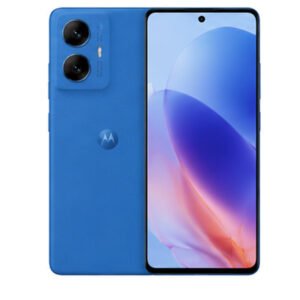

Motorola Moto G55 5G Key Features
Motorola Moto G55 5G Specifications
Body & Design
- Dimensions
- 161.56 × 73.82 × 8.09–8.19 mm
- Weight
- 179–182 g depending on finish
- Available colors
- Forest Grey; Smoky Green; Twilight Purple
- Water / dust resistance
- IP54
Network & Cellular
- Network technology
- GSM / HSPA / LTE / 5G
Software & Processor
- Operating system
- Android 14
- Chipset / SoC
- MediaTek Dimensity 7025
RAM & Storage
- RAM
- 8GB
- Internal storage
- 256GB
- Memory card slot
- microSD
- Expandable storage
- Up to 1TB microSD
Display
- Display technology
- IPS LCD
- Screen size
- 6.49 inches
- Resolution
- 2400 × 1080
- Refresh rate
- 120 Hz
- Aspect ratio
- 20:9
Camera & Video
- Rear camera setup
- 50 MP
- Ultrawide camera
- 8 MP ultrawide with autofocus and macro
- Optical stabilization
- Yes
- Rear video recording
- 1080p at up to 60 fps
- Front camera
- 16 MP
Battery & Charging
- Battery capacity
- 5000 mAh
- Wired charging
- 30W wired
Audio
- Speakers
- Stereo, Dolby Atmos
- Stereo speakers
- Yes
- 3.5mm headphone jack
- 3.5mm
Wireless & Connectivity
- Wi-Fi
- Wi-Fi 5
- Bluetooth
- Bluetooth 5.3
- NFC
- Yes, selected region
- USB
- USB Type-C
Sensors & Security
- Fingerprint reader
- Side-mounted
Durability & Repairability
- IP rating
- IP54
Price last checked: 2026-10-30
Prices may vary by variant and local market.
Moto G55 5G is a practical LCD-based 5G daily driver. Its strongest reasons to consider it are a Full HD+ 120 Hz screen, optical stabilization on its main camera and a familiar wired headphone socket. It is worth comparing with neighbouring Motorola phones instead of choosing on the model number alone: screen type, battery size, camera lens selection and regional support can change the buying decision.
This guide concentrates on what the confirmed hardware means for daily use in Pakistan, rather than treating specification figures as proof of actual speed or image quality. A Pakistan-specific official retail price, warranty route and PTA approval cannot be assumed from international Motorola listings. These details need confirmation for the particular handset before money changes hands.
Display and handling: what changes in daily use
The Moto G55 5G uses a 6.49 inches IPS LCD display with 2400 × 1080 resolution and a stated 120 Hz refresh rate. That combination helps determine how fine text looks, how smoothly long pages scroll and how comfortable the screen feels for videos or messaging. Refresh rate is not the same as game frame rate; an app must produce new frames for the screen to show them.
An IPS LCD keeps familiar colour and viewing-angle performance but cannot match the deep blacks of an OLED display. At 6.49 inches, the screen has enough room for a full keyboard and split reading, although one-handed reach depends on hand size and the case. A flat-style design also affects how a screen protector fits around the edges and how likely accidental touches are when gripping the phone.
Processor, RAM and ordinary performance
The MediaTek Dimensity 7025 drives the Moto G55 5G. Its role is to manage Android, camera processing, app launches and wireless connections. That makes the device suitable to consider for commuting, streaming, calls and dependable everyday photography. It does not establish a measured gaming frame rate or a benchmark score; those require independent testing of the same device and software version.
The documented memory configuration includes 8GB RAM with 256GB of built-in storage. More physical RAM helps keep demanding apps ready when moving between them, but it does not automatically make a slow network or poorly optimised app faster. If a listing advertises RAM Boost, remember it borrows storage capacity and is not additional physical memory.
An external memory-card option (Up to 1TB microSD) is useful for offline video, maps and photographs. A card is not identical in speed to internal storage, and some apps or protected files cannot move to it. Check whether using the card also affects the second physical SIM slot. A buyer who saves many local photos and games should calculate likely storage use before selecting a variant rather than relying on the largest headline number.
Cameras: main sensor, other lenses and video
The principal rear camera is 50 MP rear main camera with optical image stabilisation. Optical stabilisation helps reduce movement of the camera module during some exposures, especially useful indoors or after sunset; it cannot freeze a fast-moving subject by itself. Sharp results still depend on shutter speed, focus, lighting and how steady the person taking the picture remains.
The additional camera is 8 MP ultrawide with autofocus and macro. An ultrawide is useful in a small room, for broad scenery or for fitting more people into a group photo, although detail and exposure can differ from the main sensor. The camera system does not have a separately confirmed telephoto lens. Digital zoom enlarges or crops what the main sensor captures, so image detail can fall away more quickly than with true optical zoom. For a distant sign, animal or concert stage, getting physically closer when safe is often the cleaner option.
The front camera is listed as 16 MP. Resolution alone is not a quality guarantee; face detail, skin tone, dynamic range and video calling can change substantially with light and software settings. Motorola lists 1080p at up to 60 fps for supported camera modes. Check microphone capture and stabilisation on real sample clips if video matters to your work.
Battery, charging and travel practicality
A 5000 mAh battery powers the Moto G55 5G, with 30W wired charging listed for the referenced hardware. Cell capacity is not a promise of a fixed number of hours. Mobile signal quality, 5G use, brightness, background syncing, gaming and camera recording can all alter how fast charge is consumed.
A compatible charger is needed to reach the advertised maximum; actual refill times vary with heat, cable, starting charge and background activity. Wireless charging has not been established for this model, so plan around the USB-C port. A battery-friendly routine is simpler than chasing advertised charging records: keep the USB-C port clean and dry, avoid enclosing the phone in thick fabric during charging and use a reputable charger of the correct standard.
Software, network connectivity and SIM decisions
The documented software starting point is Android 14. Motorola adds its own interface controls and security features, but future Android and security-update schedules should be checked against the exact model and sales region. A phone can receive updates on a different schedule from another handset that looks almost identical.
The hardware supports 5G connectivity in its stated product family. In Pakistan, usable 5G service depends on the operator, local rollout, subscription and supported radio bands; a 5G label is not itself evidence that a particular SIM will connect at 5G speed. Likewise, Wi-Fi support such as Wi-Fi 5 and Bluetooth 5.3 should be assessed against the router and accessories a buyer actually owns.
Build quality, sound and daily trade-offs
The IP54 rating supports limited protection under defined test conditions, not deliberate immersion. A case and sensible handling remain important, particularly around sinks, rain, dust and outdoor work. The listed protection does not make a phone drop-proof. Cases and screen protectors are still sensible, especially for the corners and the camera glass.
Audio is listed as Stereo, Dolby Atmos. Stereo speakers make spoken dialogue and games feel more spatial than a single bottom-firing driver, but placement and volume can influence clarity. A 3.5mm wired headphone port is a practical advantage for existing earphones and inexpensive microphones. If you use a wireless headset for calls, test microphone performance in a busy place.
The main compromise is straightforward. Its LCD does not deliver the black levels of Motorola’s pOLED models, and IP54 resistance is more modest than full IP68-rated alternatives. That limitation may be irrelevant for some people and decisive for others. Consider it alongside the feel of the chassis, replacement screen cost and support options instead of relying on marketing labels.
Buying this Motorola in Pakistan: price and verification
A reliable current Pakistan selling price for the precise Moto G55 5G regional variant has not been independently confirmed for this import. A foreign launch price or a directory estimate should not be treated as an official local rate. Where several RAM and storage versions exist, compare the actual capacity on the box and in Settings before treating two listings as equivalent.
Ask for the full model number, IMEI-matched receipt, accessory list and written warranty terms. Verify the device’s PTA/DIRBS registration status through the proper official channels for the individual IMEI rather than assuming a brand or model family is approved. Imported stock, local retail supply and warranties are separate questions.
Alternatives and the final buying decision
Moto G56 5G increases the display size and strengthens its ingress-protection rating, while the Moto G85 5G changes to a curved pOLED screen. These comparisons should be made at the same actual RAM, storage, warranty and PTA status; an imported higher-tier model without local service may be less practical than a correctly documented midrange phone.
The Moto G55 5G is easiest to recommend to someone whose priorities are commuting, streaming, calls and dependable everyday photography. Its clearest attraction is a Full HD+ 120 Hz screen, optical stabilization on its main camera and a familiar wired headphone socket. It is less convincing if its lcd does not deliver the black levels of motorola’s poled models, and ip54 resistance is more modest than full ip68-rated alternatives. Consider these concrete constraints before paying extra for appearance, an advertised memory-boost number or a camera megapixel figure.

Motorola Moto E14
Motorola Moto G Stylus 5G

Motorola Moto G56 5G
Motorola Moto G64 5G

Motorola Moto G75 5G

Motorola Moto G85 5G
Motorola Moto G86 5G